Maintenance manual
Congratulations on your Wikkelhouse!
Proper maintenance is essential for ensuring your Wikkelhouse remains in good condition. This is not only so you can enjoy it for as long as possible, but also to ensure you meet the conditions of the warranty. You can read exactly what the warranty covers in the Wikkelhouse Terms and Conditions at https://wikkelhouse.com/wikkelhouse-terms-and-conditions/
Just like a normal house, your Wikkelhouse requires routine maintenance and periodic inspections. If you have any questions about its use or maintenance, please feel free to contact us at ajeto@wikkelhouse.com.
This manual has been compiled with the utmost care, but Wikkelhouse B.V. cannot be held liable for any errors in this user manual and/or any consequences thereof.
1. Maintenance table interior en exterior
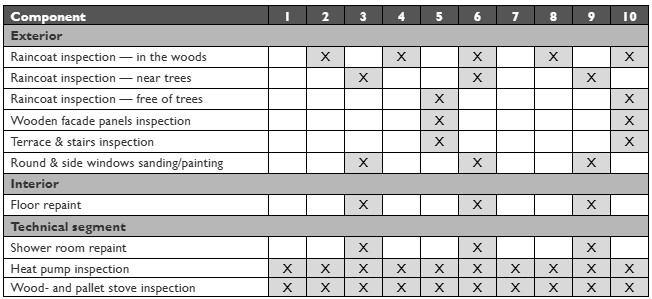
To ensure the long-term quality and durability of your Wikkelhouse, it is important to follow the maintenance instructions below. This overview is a summary; the details are described in the following sections.
2. Exterior maintenance and cleaning
To ensure your Wikkelhouse is properly maintained, it is important to first determine the environment in which it is situated. We distinguish between three environments:
- in the woods
- near trees
- completely free of trees.
In autumn, leaves can accumulate beneath the wooden cladding panels. This particularly happens on the roof. If blockages occur, damage may occur to both the waterproof membrane and the wooden panels. Have this checked periodically, and cleaned if necessary: in the woods every 2 years, near trees every 3 years, and in areas free of trees every 5 years. We are happy to be involved in this inspection, but you can also carry it out yourself in consultation with us.
2.1 The raincoat
- Wikkelhouse segments are joined together using steel threads (and no glue). This strong connection prevents leaks between the segments. The exterior is fitted with a waterproof and vapour-permeable membrane, similar to breathable rainwear.
- Wikkelhouse has no gutter but an ‘open façade’. The raincoat channels rainwater downwards along the waterproof membrane.
- It is important that rainwater can run freely down the raincoat and drip to the ground along the curved section at the bottom.
- Are you unsure about the condition of the membrane? Take a photo and email it to ajeto@wikkelhouse.com. We can then advise you.
- With proper maintenance and timely inspection, we expect the raincoat to function effectively and remain watertight for at least 15 years.
- Would you like to remove the cladding yourself for an inspection? Please contact us first at ajeto@wikkelhouse.com for instructions.
Please note: Incorrect installation or removal, or the use of the wrong screws, may damage the raincoat, with a risk of leakage.
2.2 Wooden cladding and window frames
Thermally treated pine has been used for the exterior cladding. This protects the raincoat from UV. The wood weathers naturally and does not require any treatment. Check every five years to ensure that all slats and panels are still securely fastened. We sometimes see some moss growth on the cladding; this does not affect the quality of the cladding and therefore does not need to be removed.
The window frames in the gables are also made of thermally treated timber. In some places, dark discolouration caused by water may occur. This is not a problem, provided the timber is always allowed to dry properly.
2.3 Terrace & stairs
The terrace and stairs (like the cladding) are made of thermally treated pine. Clean the terrace and stairs regularly and remove any algae with a stiff brush as soon as it becomes slippery.
Please do not use the space under the stairs of the Wikkelhouse for storage — this ensures optimal airflow and allows the house to dry properly.
Inspect the terrace and stairs every 5 years for subsidence and rot, and check the condition of the joints.
2.4 Round and side windows
The frames of the round windows and the side windows with black-painted frames should be sanded and painted once every three years.
3. Interior maintenance and cleaning
3.1 Heating and ventilation
You can keep your Wikkelhouse in top condition by cleaning it regularly, airing it out and maintaining a humidity level of between 50% and 60%. Humidity is affected by temperature. We therefore recommend keeping your Wikkelhouse at a minimum temperature of 14 degrees Celsius.
Ventilation and heating go hand in hand. Ventilation brings in drier air and prevents moisture build-up; the heat pump keeps the temperature above the dew point. Together, they prevent mould growth and damage to the woodwork.
There are three ways to ventilate:
- Via the ventilation flaps in the facades — these only work when there is a pressure difference between inside and outside. A pressure difference is created by letting in outside air, for example by opening a window.
- By regularly opening the windows and/or doors.
- By switching on the mechanical ventilation system and setting it to the desired setting.
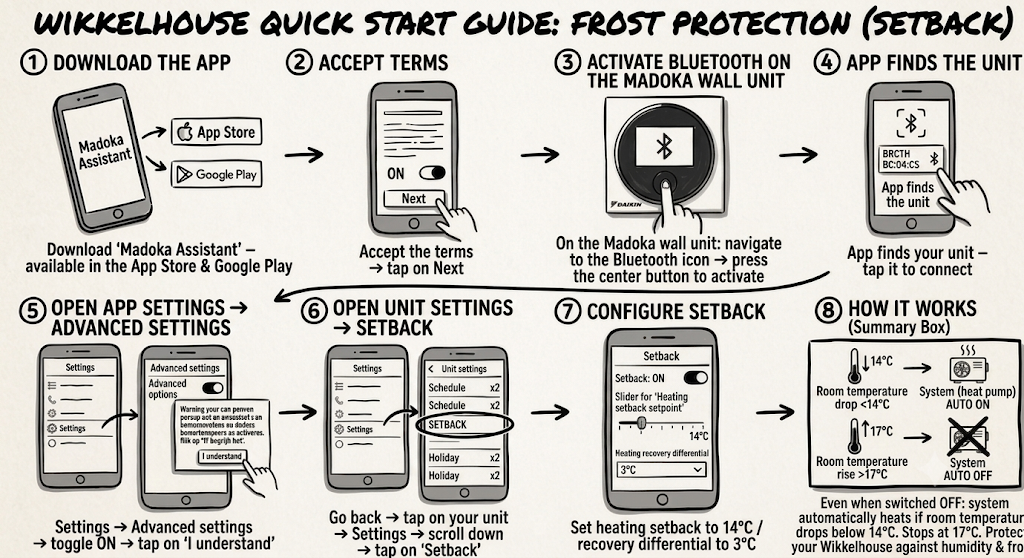
Do not leave your Wikkelhouse completely unheated if you are away for a long period. When you are away, use the heat pump’s frost protection function: this switches on automatically as soon as the temperature drops below 14 degrees. Make sure the house remains well ventilated.
Allow the house to slowly return to room temperature when you move back in. Natural materials such as wood shrink and expand. Rapid changes in temperature can cause cracks or fractures.
3.2 Floor
The floor and the lower parts of the walls have been coated with a water-based parquet lacquer.
- Clean with a damp mop. Do not use too much water; it is best to keep the seams dry.
- Is water getting into the seams? Wipe it out with a dry cloth and make sure you ventilate the house properly so that the seams can dry thoroughly.
- Repaint the floor every 3 to 5 years. Use a water-based parquet varnish. Please note: The pine plywood has a 2 mm top layer. Sand only lightly (flat sanding/vibrating). Never sand through the top layer.
3.3 Walls
The design principle behind Wikkelhouse is ‘less is more’, but if you do want to fix something to the wall, please do so with care. The curved walls are made of 9 mm plywood. A screw in the wall could damage the insulation.
If you do want to screw something into the wall, use a screw no longer than 3 cm. This can only be done 2 cm to the left or right of the seam (where the segments are joined), or exactly in the middle of a segment (61 cm from the seam).
3.4 Pests
The house has not been treated with any pesticides. So far, there have been no problems with damage caused by insects or mice. If, against all odds, you do encounter pests, please take appropriate measures depending on the type.
3.5 Fire safety
Every Wikkelhouse is equipped with a smoke detector and a fire extinguisher. Always take care when using open flames and candles, and keep the exits clear of obstacles.
4. Technical segment
4.1 Kitchen
The worktop is made from plywood, bonded with waterproof glue and coated with a waterproof two-component lacquer. Clean it with warm water and a standard all-purpose cleaner. Use a standard kitchen cloth — do not use a scouring pad or abrasive cleaner.
The worktop is not heat-resistant. Always use a trivet.
For kitchen appliances, please refer to the maintenance instructions and manufacturer’s warranties provided by the relevant manufacturers.
4.2 Shower room
Like the interior of the Wikkelhouse, the shower room is constructed from plywood panels. A waterproof two-component lacquer has been used in the shower room to protect the wood from shower water.
- Dry the shower area, including the window frame, after showering.
- Clean regularly using a standard all-purpose cleaner and ensure there is good ventilation.
- Check the paintwork every 3 years. Over time, small hairline cracks may appear in the paint. This causes blisters to form, meaning the wood is no longer protected against water. The formation of hairline cracks can be prevented by drying the shower area with a cloth after use. If hairline cracks do appear, the shower area must be sanded down and repainted with a two-component lacquer.
4.3 Technical installations
4.3.1 Heat pump
Is your Wikkelhouse fitted with a heat pump? Have it checked once a year by a certified installation company.
The meter cupboard doors are fitted with ventilation grilles. Air for the heat pump is drawn in through these grilles. Clean these grilles monthly using a vacuum cleaner from the outside, to ensure the heat pump operates at its best.
4.3.2 Fuse box & water meter
In most Wikkelhouses, the meter cupboard is located next to the bathroom door. The fuse box is at the top of the cupboard and the water meter at the bottom. In the event of an emergency, the electricity and water can be shut off here. The water pipes here are fitted with heating tape to prevent them from freezing.
4.3.3 Wood- or pelletstove
Does your Wikkelhouse have a wood or pellet stove?
- Keep a minimum distance of 1 metre between the front and sides of the stove, the windows and any flammable materials.
- Have the pipe and chimney inspected and cleaned at least once a year.
5. Moving and/or modifying your Wikkelhouse
A Wikkelhouse is relatively easy to move, and this is done in the same way as during assembly. The time required for assembly, disassembly and relocation depends entirely on the number of segments, the travel distance and the accessibility of the site.
The Wikkelhouse is founded on concrete beams or screw piles topped with wooden joists. Both types of foundation are removable.
Do you have any questions, or is anything in this Maintenance Manual unclear? Please feel free to contact us at ajeto@wikkelhouse.com.
You can also download the maintenance manual through this link